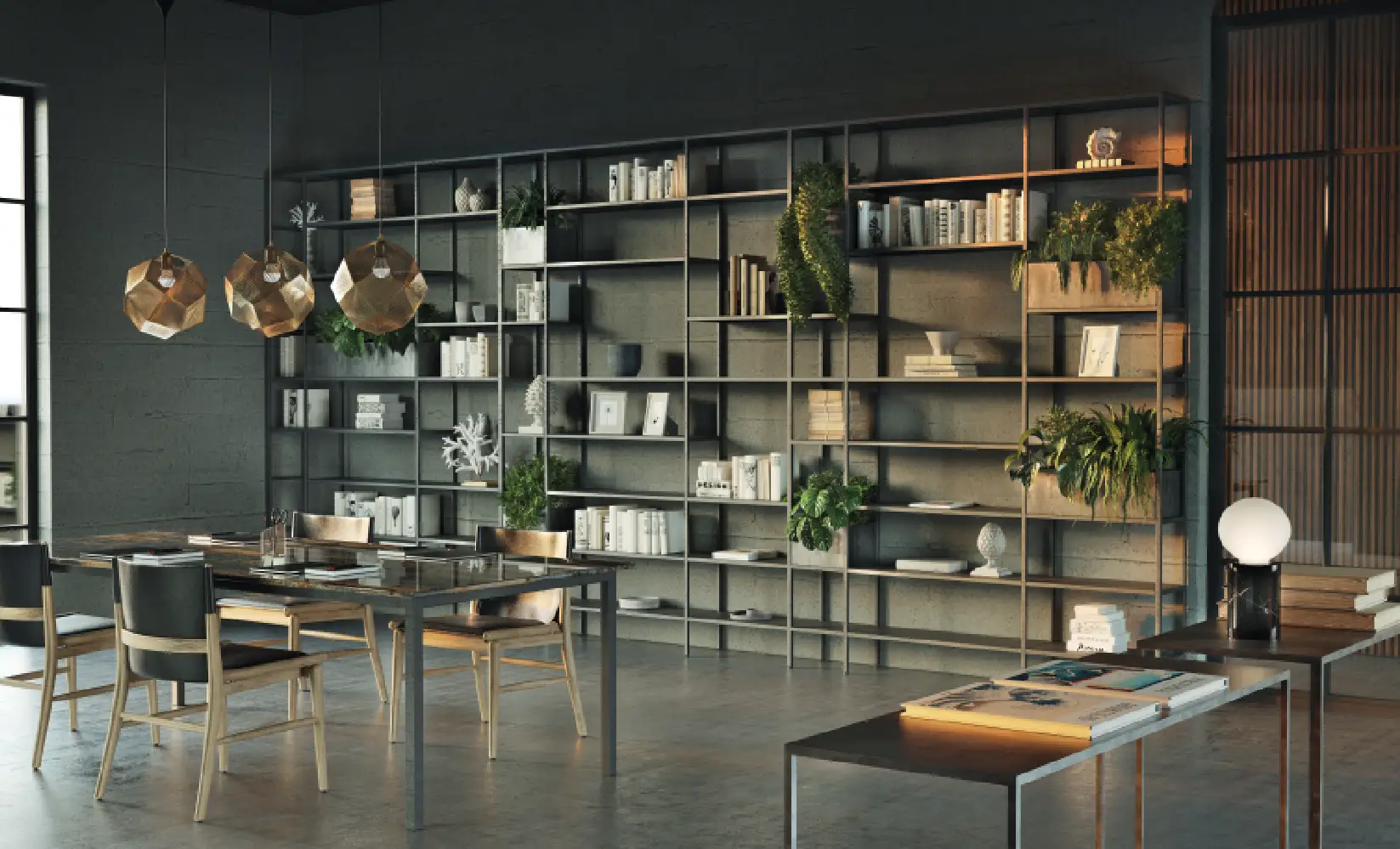
https://www.siderio.it/en/product-category/bookshelves-and-bookcases/When discussing bookcases and bookshelves for interiors, people often think of furniture elements simply designed to hold books, objects or accessories. In contemporary design, however, the bookcase can take on a broader role. It can become a light wall, a dividing element, a visual backdrop or a structure capable of giving rhythm to an interior.
Freestanding modular metal bookcases respond precisely to this need: creating flexible, resistant and visually lightweight furniture systems that can adapt to different spaces without necessarily depending on a load-bearing wall or a fixed installation.
In custom design and modular metal systems, bookcases and bookshelves are no longer just pieces of furniture, but become design structures.
Contenuti
What are freestanding modular metal bookcases and bookshelves?
Freestanding modular metal bookcases are furniture systems made of metal, composed of repeatable, configurable and combinable elements. Unlike a traditional bookcase, they are not conceived as a single closed block, but as an open system capable of adapting to different spatial, functional and compositional needs.
The term “modular” refers to the possibility of creating different configurations through coordinated elements: side panels, shelves, cubes, uprights, storage modules or accessories. The term “freestanding” refers to the structure’s ability to support itself independently, without relying exclusively on wall fixing.
This combination makes metal bookcases and bookshelves particularly interesting for residential, contract and interior design projects, because it allows for flexible, lightweight and customizable solutions.
Why choose metal for a modular bookcase or bookshelf system?
Metal is one of the most effective materials for creating freestanding modular bookcases and bookshelves, because it combines structural strength with visual lightness.
Compared to other materials, metal allows the use of thin profiles, reduced sections and essential structures while maintaining good load-bearing capacity. This is essential when the goal is to create elegant, minimal bookshelves without visually weighing down the space.
A metal bookcase or bookshelf system can be designed to be:
- Thin but resistant
- Modular but stable
- Decorative but functional
- Visually lightweight but structurally solid
- Adaptable to different environments and configurations
The value of metal lies not only in its strength, but in the possibility of creating a precise, durable system that is consistent with the interior design project.

Freestanding does not mean free from technical evaluation
A freestanding bookcase is designed to support itself, but this does not mean it can be placed in any context without technical assessment.
Freestanding stability depends on several factors:
- Overall height of the structure
- Depth of the base
- Load distribution
- Position within the room
- Balance between solids and voids
- Presence of double-sided or single-sided elements
- Intended use of the bookcase or bookshelf system
Very tall, slim or heavily loaded bookshelves always require design verification. In some cases, even when the bookcase structure is freestanding, a safety fixing to the wall may be recommended, especially to increase stability and safety in everyday use.
In interior design, therefore, freestanding should not be understood as the absence of constraints, but as greater compositional freedom supported by proper technical evaluation.
Modularity: adapting bookcases and bookshelves to space and use
Modularity is one of the main advantages of freestanding metal bookcases and bookshelves. A modular system makes it possible to create different compositions starting from coordinated elements, adapting the bookcase to the available space and desired function.
A modular bookcase or bookshelf system can be used to:
- Furnish a living room wall
- Separate two areas without closing them off
- Create a double-sided element
- Organize books, objects and plants
- Integrate storage units or special modules
- Follow the evolution of the space over time
In a residential project, this flexibility makes it possible to create less rigid solutions than fully fixed furniture. In a contract project, it allows dynamic spaces to be managed more easily, such as offices, showrooms, hospitality environments or commercial spaces.
Modularity turns the bookcase into an open system, not simply a finished piece of furniture.
Freestanding bookcases and bookshelves as dividing elements
One of the most interesting applications of freestanding modular metal bookcases and bookshelves is their use as dividing elements.
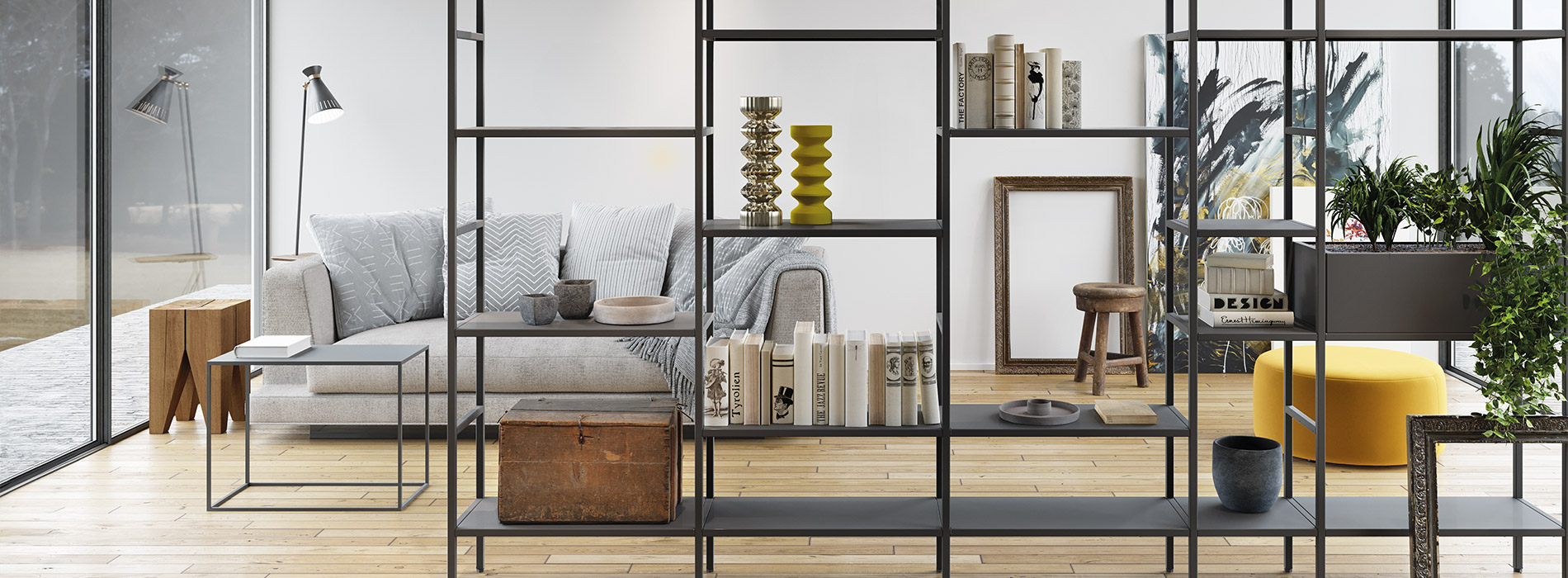
Unlike a solid wall, an open bookcase allows spaces to be separated while maintaining visual continuity, light transmission and connection between rooms. This makes freestanding metal bookshelves particularly suitable for projects where the goal is to divide without closing.
They can be used, for example, to:
- Separate entrance and living area
- Create a study area within an open space
- Divide living and dining areas
- Organize an office space
- Create a decorative backdrop in a contract environment
In this case, metal makes it possible to create thin, rhythmic structures capable of defining space without making it feel heavy.

Double-sided bookcases: when the bookcase interacts with two spaces
Freestanding metal bookcases can also be designed as double-sided systems. In this case, the bookcase is not intended to be placed against a wall, but to be seen and used from both sides.
A double-sided bookcase requires particular attention to:
- Structural stability
- Finish on both fronts
- Proportions between solids and voids
- Weight distribution
- Quality of the joints
- Visual continuity
Compared to a wall-mounted bookcase, the double-sided system has a more architectural function. It does not merely contain objects; it participates in defining the environment.
For this reason, metal is particularly suitable for double-sided bookcases and bookshelves: it allows for a solid, precise and visually lightweight structure even when the element is positioned at the center of the space.
Difference between modular, configurable and custom bookcases
In everyday language, the terms modular, configurable and custom are often used as synonyms. In reality, they refer to different concepts.
A modular bookcase is based on repeatable elements that can be combined in different configurations.
A configurable bookcase allows multiple parts to be assembled to create a solution adaptable to space and use.
A custom bookcase, on the other hand, is developed from a specific project, defined according to measurements, context, finishes, constraints and aesthetic goals.
In metalwork, these three levels can interact. A modular bookcase system can be customized in finishes, dimensions or accessories. Custom bookshelves can adopt a modular logic to simplify transport, installation and future reconfiguration.
The choice depends on the type of project: the more specific the context, the greater the value of custom design.

Existing conditions: why context also affects a freestanding bookcase
Even a freestanding bookcase must respond to the real space in which it will be installed.
Existing conditions may include:
- Floors that are not perfectly level
- Out-of-square walls
- Sloped or misaligned ceilings
- Narrow passages
- Transport constraints
- Need to protect existing floors or finishes
These factors can affect design choices. An uneven floor may require adjustable feet or compensation systems. Limited access may require a demountable structure. A space with specific aesthetic constraints may require dedicated finishes or proportions.
For this reason, even when metal bookcases and bookshelves are not fixed directly to the wall, context remains a determining design variable.
Stability, loads and safety
In a metal bookcase or bookshelf system, stability does not depend only on the material, but on how the structure is designed.
A bookcase may be made of steel, have resistant profiles and durable finishes, but it still needs to be dimensioned consistently with its intended use. Books, objects, vases, decorative elements and devices can generate different loads, distributed in non-uniform ways across the shelves.
The aspects to be evaluated include:
- Weight of the objects to be stored
- Load distribution on the shelves
- Height of the structure
- Depth and floor support
- Possible double-sided use
- Presence of children or high-traffic environments
A well-designed freestanding metal bookcase is the result of a balance between proportions, material, geometry and technical control.
Materials and finishes for modular metal bookcases and bookshelves
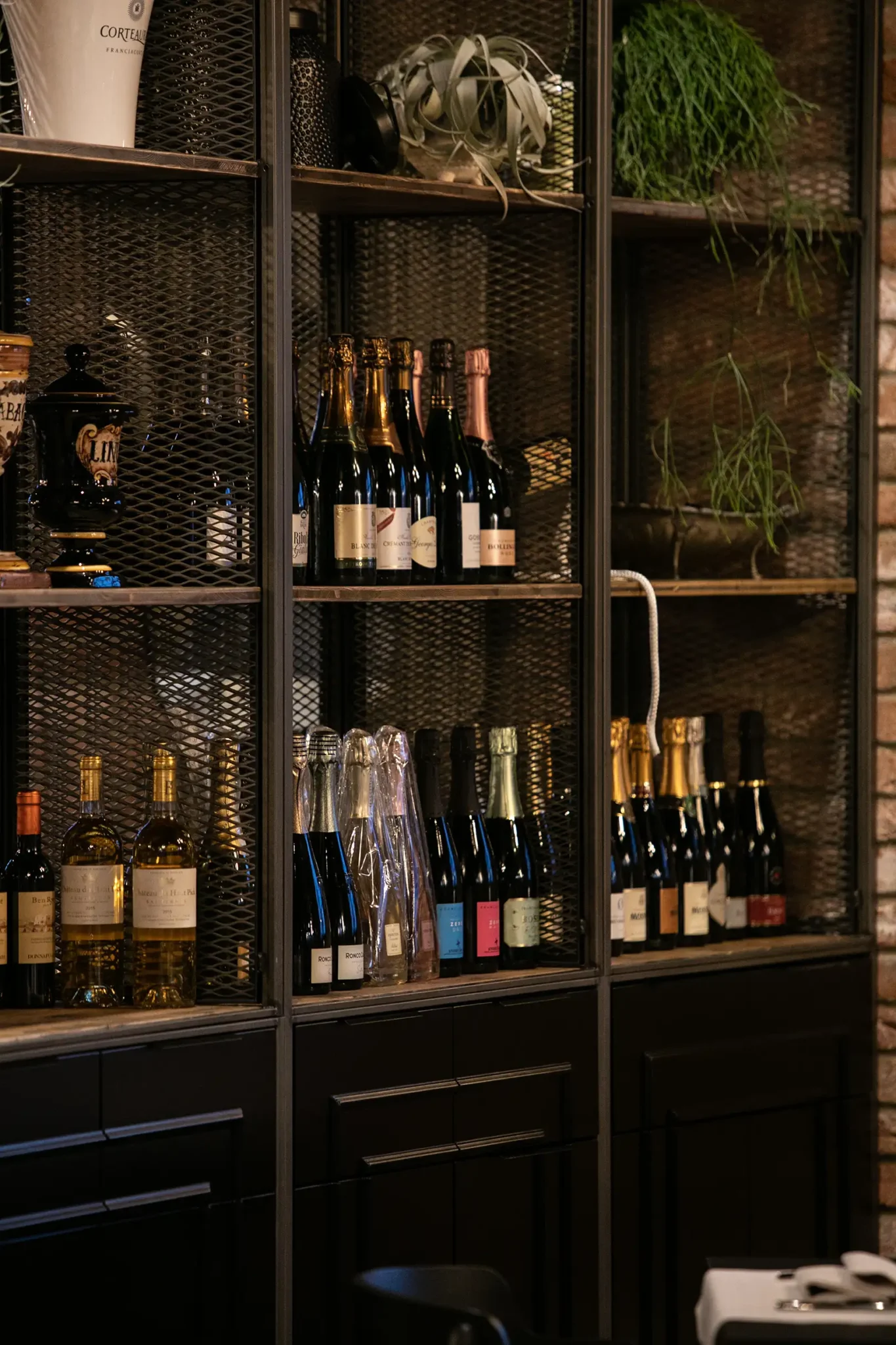
Modular metal bookcases and bookshelves are often made of painted steel, because this material offers an effective balance between strength, workability and aesthetic possibilities.
Finishes play a fundamental role. A metal bookcase or bookshelf system can take on a very different character depending on the treatment chosen:
- Powder coating
- Textured finishes
- Bronze, copper or brass effects
- Protected natural steel
- RAL or NCS colours
- Special finishes on request
A light finish can make the structure more discreet and visually lighter. A dark finish can turn it into a strong graphic element. A textured finish can bring the bookcase closer to the language of architecture, making it not only a storage element, but also a surface and a design presence.
In custom metalwork, the finish is not a final detail: it is part of the object’s identity.
Where to use freestanding modular metal bookcases and bookshelves
Freestanding modular metal bookcases and bookshelves can be placed in many different contexts, because they combine flexibility with architectural presence.
They are suitable, for example, for:
- Contemporary living rooms
- Entrances and transition areas
- Home offices
- Offices and executive spaces
- Showrooms
- Boutiques
- Restaurants and hospitality spaces
- Covered outdoor areas, when designed with suitable materials and finishes
Their main advantage is the ability to adapt to different functions: containing, dividing, displaying, decorating and organizing.
This versatility makes freestanding metal bookcases and bookshelves an interesting solution for architects and interior designers looking for an element that can interact with space without closing it off.
When to choose a freestanding bookcase and when to choose a wall-mounted bookcase
The choice between a freestanding bookcase and a wall-mounted bookcase depends on the project.
A freestanding bookcase is suitable when the goal is to:
- Maintain greater freedom of positioning
- Avoid a fully wall-dependent installation
- Create a light division between spaces
- Design a double-sided structure
- Obtain a reconfigurable system
A wall-mounted bookcase is more suitable when the goal is to:
- Use an existing wall
- Increase the stability of a very tall structure
- Integrate the bookcase into boiserie or a wall system
- Reduce floor footprint
- Create continuity with other architectural elements
In many cases, the best solution comes from a balance between the two approaches: a freestanding structure with safety fixings, or a modular bookcase system integrated with custom elements.
The role of in-house design
To create freestanding modular metal bookcases and bookshelves, defining dimensions and shelves is not enough. Proportions, stability, loads, finishes, transport, installation and relationship with the space must all be evaluated.
The presence of an in-house technical office makes it possible to transform an idea into a system that can actually be manufactured and installed. This is particularly important when the bookcase must be:
- Very tall
- Very slim
- Double-sided
- Demountable
- Integrated with other elements
- Customized in its finishes
- Installed in a complex architectural context
The value of design lies not only in the drawing, but in the ability to anticipate what happens next: production, handling, assembly and everyday use.
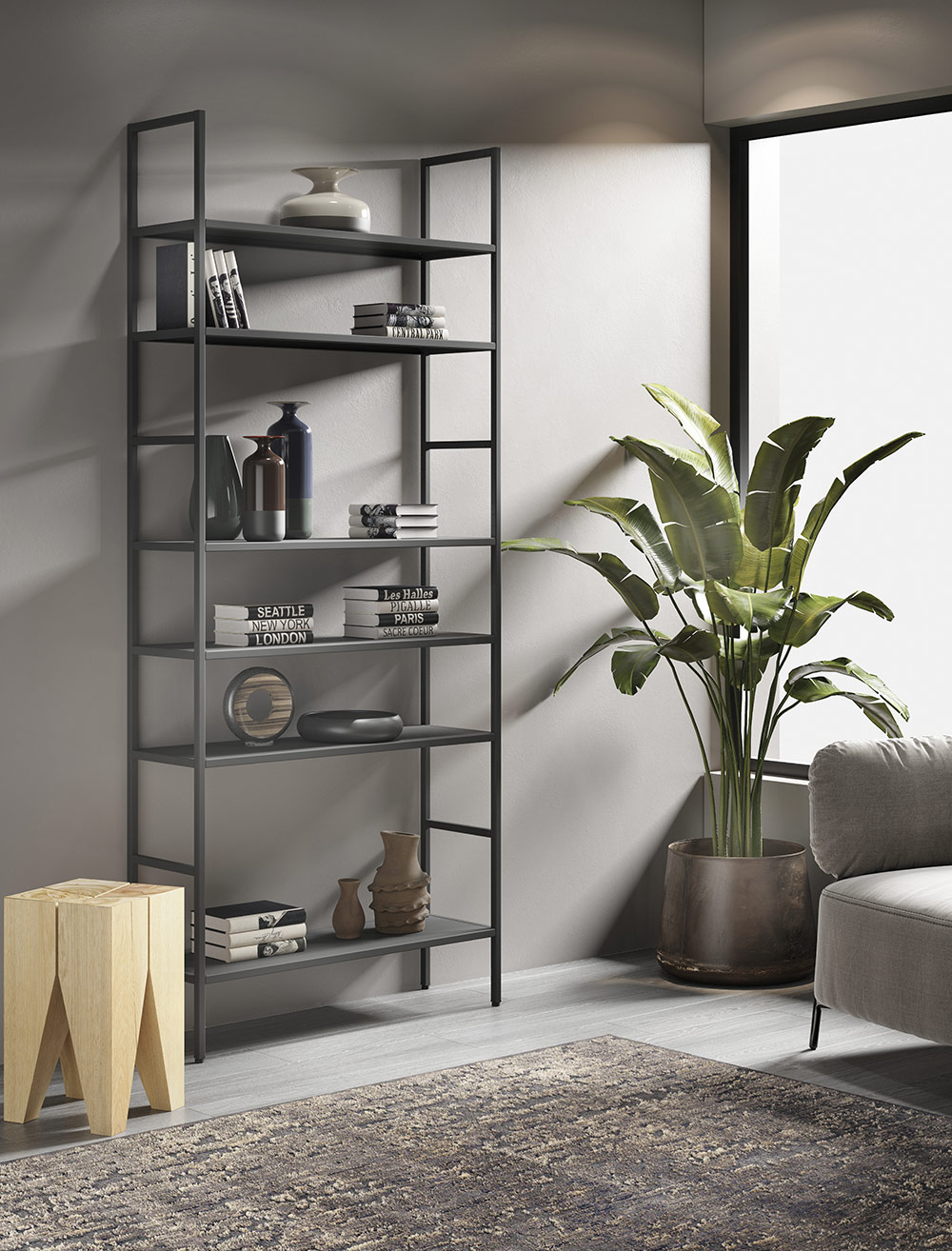
Freestanding modular metal bookcases, bookshelves and interior design
In contemporary interior design, freestanding modular metal bookcases and bookshelves can become much more than storage elements.
They can be lightweight structures, backdrops, graphic signs, permeable walls or systems capable of evolving with the space. Metal allows for thin profiles and clean design, while modularity makes it possible to create adaptable configurations.
For this reason, choosing a freestanding modular metal bookcase means choosing an element that combines function, architecture and flexibility.